Evangelical anti-drug handbook by William Goodman, published late 1960s–early 1970s, paperback.
Category: Curated
File Under: #DrugWar, #MoralPanic, #Ephemera, #ACAB
Description
Paperback handbook addressing drug use, authored by William Goodman and published by Baker Book House, Grand Rapids, Michigan. The book presents itself as an educational guide intended for parents and school-aged children, offering instruction on drugs, alcohol, and tobacco.
Authorship is explicitly framed through institutional authority. Goodman is identified as both a pastor of the First Church of the Nazarene in Streator, Illinois, and a police officer with nine years of experience handling street-level drug enforcement. The text positions itself as corrective and preventative, emphasizing discipline, abstinence, and moral clarity.
The book’s language collapses drugs, alcohol, and tobacco into a single category of social threat, presenting drug use as a failure of judgment rather than a social, medical, or economic condition. Endorsement from a municipal court judge appears on the back cover, reinforcing its intended role as an instrument of instruction and behavioral regulation.
Produced during the early period of the modern War on Drugs, the book reflects a moment when religious doctrine, law enforcement, and public education converged in printed form to stabilize social norms perceived to be under threat. Its design, distribution format, and tone indicate a mass-circulated object meant for repeated handling rather than preservation.
Now removed from its original instructional context, the book functions as a record of how certainty was manufactured, distributed, and enforced through accessible media.
Evangelical anti-drug handbook by William Goodman, published late 1960s–early 1970s, paperback.
Category: Curated
File Under: #DrugWar, #MoralPanic, #Ephemera, #ACAB
Description
Paperback handbook addressing drug use, authored by William Goodman and published by Baker Book House, Grand Rapids, Michigan. The book presents itself as an educational guide intended for parents and school-aged children, offering instruction on drugs, alcohol, and tobacco.
Authorship is explicitly framed through institutional authority. Goodman is identified as both a pastor of the First Church of the Nazarene in Streator, Illinois, and a police officer with nine years of experience handling street-level drug enforcement. The text positions itself as corrective and preventative, emphasizing discipline, abstinence, and moral clarity.
The book’s language collapses drugs, alcohol, and tobacco into a single category of social threat, presenting drug use as a failure of judgment rather than a social, medical, or economic condition. Endorsement from a municipal court judge appears on the back cover, reinforcing its intended role as an instrument of instruction and behavioral regulation.
Produced during the early period of the modern War on Drugs, the book reflects a moment when religious doctrine, law enforcement, and public education converged in printed form to stabilize social norms perceived to be under threat. Its design, distribution format, and tone indicate a mass-circulated object meant for repeated handling rather than preservation.
Now removed from its original instructional context, the book functions as a record of how certainty was manufactured, distributed, and enforced through accessible media.
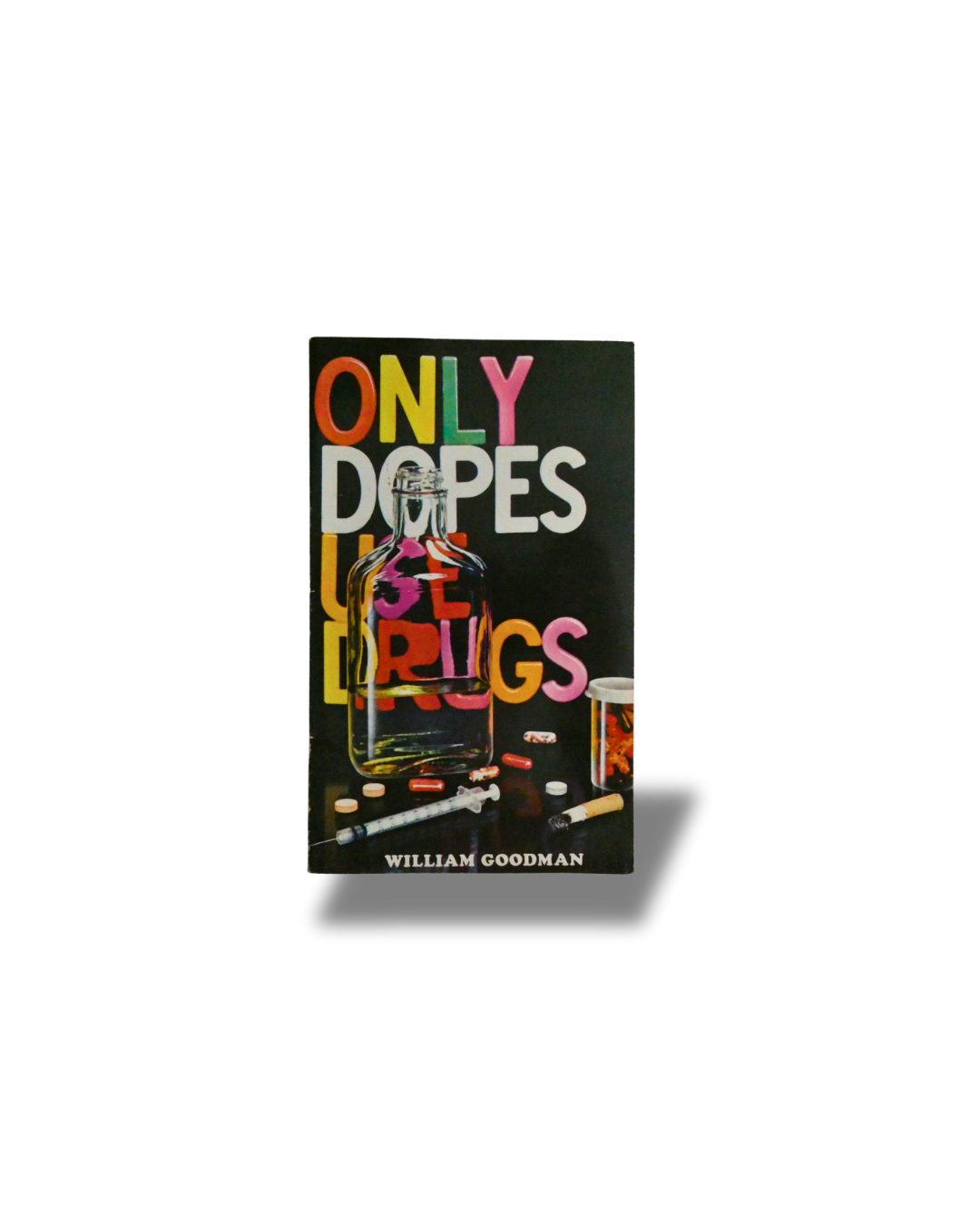 Image 1 of 1